
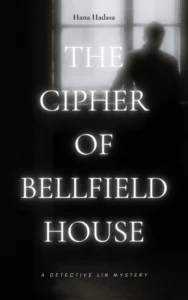
 Chapter One — The Arrival
I first encountered Detective Edmund Gray on a morning thick with autumn mist, the kind that clings to the eaves of buildings and blurs the edges of reality. London in October possesses a peculiar stillness; the bustle continues unabated, yet one gets the sense of some unseen mechanism turning, slowly, inexorably. Gray moved within that stillness like a deliberate thought — precise, alert, and impossible to overlook.
I was seated at the café on Milner Street, nursing a tepid cup of coffee and orchestrating my notes for the week, when Gray approached. He was tall and lean, with an angular face framed by dark hair beginning to streak with silver. His eyes, sharp and observant, scanned the room before settling on mine with a faint hint of amusement.
“Good morning, James,” he greeted, his voice low and measured. I rose promptly from my seat, for Gray’s summons were never idle. “Shall we?”
He offered no further explanation, but he never did. I knew to follow without question.
A sleek black sedan awaited us outside. Gray slid into the backseat with the calm precision of a man who had wrestled with chaos before and found it yielding to logic.
“The Home Office has requested my involvement in a matter of some delicacy,” Gray said, the briefest of pauses punctuating his words. “An apparent murder at a stately home called Bellfield House. The Secretary of State wishes it handled discreetly.”
I nodded. A murder in an English country estate — a scenario that might have seemed cliched in lesser hands — held promise of deeper currents beneath its surface. Gray’s instincts did not steer him toward trivialities.
“Bellfield House,” I echoed, settling into the leather seat. “How modern a crime scene?”
Gray’s features tightened slightly, not in displeasure but in contemplation. “In this case, James, modernity breeds old sins.”
Chapter Two — Bellfield House
Bellfield House stood on the fringes of Surrey — an estate whose grandeur had withstood time’s eroding breath but nonetheless whispered of secrets sealed in its walls. Its façade, a blend of Georgian dignity and contemporary restoration, spoke of wealth maintained through successive generations.
We arrived as the autumn sun was still low, casting long shadows that sliced through the coppice surrounding the estate. A low hum of activity greeted us: police vans, forensic units, and uniformed officers fanning out across the gravel courtyard. Yet amid the orchestrated bustle, a testament to modern investigative rigor, stood a pervasive hush — as though Bellfield itself held its breath.
Detective Chief Inspector Lyle awaited us at the sprawling oak doors, eyes weary yet alert. His greeting was curt but polite.
“Detective Gray,” he said. “Thank you for coming. We’ve a dreadful puzzle here.”
Gray inclined his head once, then surveyed the house. There was something almost reverential in his stillness — as if he listened first to the rhythm of the place before engaging its people.
Inside, we entered a grand hall adorned with ancestral portraits and a chandelier that caught the soft morning light like droplets of subtle accusation. The air carried a faint trace of expensive cologne and fear.
“Victim is Lord Conrad Ashbury,” DCI Lyle informed. “Found in his study late last night — shot. No sign of forced entry. No witnesses thus far.”
Gray raised a single brow — an expression that always warned of deeper inquiry.
“And the weapon?”
“Not yet located,” Lyle replied. “There’s more — Ashbury was due to host an international summit here today. Delegates from multiple nations. Significant negotiations.”
Gray didn’t flinch. “Coincidence seldom stands alone.”
Chapter Three — The Study of Shadows
Lord Conrad’s study was a room at once grand and intimate: walnut bookshelves crammed with leatherbound volumes; a globe that bore faded lines of old empires; and a desk strewn with documents awaiting ashtray embers from the previous evening. On the Persian rug lay a single reddish stain, preserved beneath markers and tape.
Gray had asked me to stand quietly by as he examined every detail — a habit I had grown accustomed to yet never ceased to admire. With measured gestures, he paced the room’s perimeter, then crouched by the desk.
“Observe, James,” he murmured. “There was no struggle. Note the position of this note tucked beneath a blotter.”
He held up a small slip of paper, on which was scrawled a series of letters and numbers that danced between code and chaos:
“F-16 / Calla – K15 – Ember / 22:30”
“No obvious meaning yet,” he said softly, securing it in an evidence bag, “but such things seldom exist without purpose.”
I glanced at the documents — a half-written letter bearing Ashbury’s signature sat beside contracts and diplomatic memoranda. The immediacy of the summit might well have placed additional stress upon Lord Ashbury, but stress alone rarely suffices as motive for murder.
“Do you think he deciphered something he shouldn’t have?” I ventured.
Gray’s gaze lifted to the towering shelves. “An estate such as this holds many stories, James. And some speak more clearly than others.”
Chapter Four — The House Party
As word of Lord Ashbury’s death spread, the scheduled summit remained stood down; yet the guests were all present — a retinue of diplomats, academics, financiers, and cultural envoys. Bellfield House had transformed, in the span of a single night, into a cross between a fortress and a theater, the audience uncertain whether it watched a tragedy or a farce disguised as diplomacy.
Among the attendees were:
-
Dr. Helena Sato, cultural envoy from Japan — poised, analytical, yet visibly unsettled.
-
Ambassador Lars Weniger, a tall, reserved man from Scandinavia, whose folded arms hinted at inner conflict.
-
Ms. Penelope Ashbury, Lord Ashbury’s niece, radiant with controlled grief that flickered now and then like an unsteady flame.
-
Mr. Silas Cole, a financier with ties to global energy interests — mercurial and unguarded.
Gray had already begun speaking privately with each guest, his questions delivered with precision yet without intimidation — an approach that encouraged honesty in those accustomed to deception.
“I find that confidence unearned often despairs first,” Gray once told me, glancing from a guest’s forced smiles to their darting eyes. It was a principle he applied consistently.
Chapter Five — A Cipher in Plain Sight
Throughout the afternoon we were summoned repeatedly by fragments of information: a secret communiqué found in Ashbury’s safe; a garden key recovered near the scene; whispers of foreign interests intertwined with Bellfield’s own storied history.
I should note at this juncture that Gray’s mind worked in a manner reminiscent of well-tempered clockwork. Each new piece of data, no matter how insignificant it seemed, was given precise consideration. Nothing escaped his scrutiny.
Late in the day, as dusk softened the estate’s outer lawns to shadow, Gray beckoned me toward the library — its French doors ajar, light leaking in like an invitation.
“James,” he said with measured calm, “I believe I have found the connective tissue.”
In his hand, beneath the soft glow of an antique lamp, lay a faded envelope addressed to Ashbury many months prior. The return address had been erased, yet the postmark remained legible: Bellfield — March 12.
“I think someone here is unaware that they’ve overlooked something obvious,” Gray murmured, as his eyes drifted over a row of leatherbound volumes. He reached for a book on vexillology — the study of flags.
Within its pages was tucked a slender bookmark — identical to the coded note we had found earlier.
The implications were immediate: someone had inserted the cipher into a volume that was outwardly innocuous, knowing it might later be revealed by an unsuspecting hand. The choice of a book on flags — symbols of nations, alliances, and identities — suggested the cipher pertained to something political.
“This murder,” Gray pronounced, “was not merely personal. It was a message.”
Chapter Six — Patterns and Deductions
Over the next hours, we dissected the cipher meticulously. Gray placed the numbers and names before me on a large oak table. Calla, Ember — two words with no immediate link, until I noticed something:
Both “Calla” and “Ember” were names of experimental energy initiatives under contract with Ashbury’s consultancy firm — projects fraught with international tension. The letters F-16 and K15 might then correspond to internal classification codes for sensitive data repositories.
Gray nodded slowly as recognition lit his eyes.
“Someone intended for Ashbury to know that information was compromised — that confidence in these projects was no longer secure,” he said.
Yet who would benefit from such exposure? And why murder him?
As night deepened and the estate’s lighting took on specters of illumination, Gray and I returned to examine the garden key discovered earlier. It opened a small outbuilding once used for horticultural tools — now repurposed as a storeroom.
Inside we found a folder bearing a single label: “Project Calla — Confidential.”
The contents comprised correspondence between Ashbury and a consortium seeking to broker a groundbreaking renewable energy agreement — one that might reconfigure geopolitical power balances.
Among the documents was a single email thread that bore the unmistakable hallmarks of coercion: untraceable IP addresses; veiled threats; veiled warnings to withdraw from negotiations.
“We have our motive,” Gray murmured.
Chapter Seven — The Confrontation
It was near midnight when the clues coalesced into a decisive confrontation. Gray had assembled the principal attendees in the grand dining room — the same room where hours earlier the estate’s veneer of hospitality had given way to apprehension.
He addressed them with calm clarity.
“Lord Ashbury was murdered because he discovered that confidential information regarding Project Calla was being exploited by interests seeking to manipulate global energy markets,” Gray began. “This was planned to pressure him into renegotiations that favored certain parties.”
Gasps rippled through the assembled guests.
“I have reason to believe,” Gray continued, “that the person responsible for his death is present here tonight — someone whose motives extend beyond financial gain into the realm of power and influence.”
All eyes turned toward Silas Cole, whose demeanor had been unsettlingly serene throughout the day.
“Mr. Cole,” Gray said, “you have investments tied intimately to unstable energy contracts. Exposure of the information Lord Ashbury possessed would affect your portfolio substantially.”
Cole’s face twitched, but he denied it with practiced composure.
“And yet,” Gray went on, “your correspondence with intermediaries — discovered in the Project Calla folder — clearly outlines your intent to neutralize Ashbury’s influence.”
The room stood still.
“I did not kill him,” Cole protested. “I merely sought advantage.”
Gray withdrew a statement from Ashbury’s safe — one that implicated Cole in covert pressure tactics but also hinted at a hidden partnership: Cole had conspired with an insider within the Bellfield estate.
At this, all eyes fell upon Dr. Helena Sato.
Her expression broke — not in guilt, but in profound anguish.
“It was meant to be a warning,” she whispered. “Not a death sentence.”
Gray fixed his gaze upon her with a measured intensity.
“You admitted to intercepting Ashbury’s emails and using the cipher to gauge his understanding of certain project vulnerabilities,” Gray said. “You feared that without leverage, Project Calla would be compromised. You never intended murder — only leverage.”
Her shame was palpable.
“I confronted him in the study,” she said in a quiet voice that trembled like unstrung wire. “He refused to alter the negotiations. I lost control.”
Gray stepped forward, unconvinced.
“Dr. Sato, you are responsible for deceit — but not for the shot that killed Lord Ashbury.”
He turned to Penelope Ashbury, who had watched the exchange from near the mantelpiece. In her hand was a small revolver, its barrel still cool.
She wept softly.
“He begged me not to tell everyone about a private matter,” she said. “I saw him reach for something — I panicked.”
Silence ensued.
Chapter Eight — Truth in the Gloaming
The revolver discharged only once — the accidental result of a frightened grip. The trajectory, the forensic team later confirmed, matched the wound in Lord Ashbury’s chest. An inquiry ensued, and the truth was laid bare: a tragic triangulation of fear, pressure, and miscommunication. The murder was not the machination of global conspiracy after all, but the confluence of hidden anxieties among those closest to the victim.
Cole’s manipulations were criminal yet non-violent; Dr. Sato’s espionage was ethically compromised but born of professional zeal; and Penelope’s deed, though unintended, was the final, heart-shattering outcome of a love strained by secrecy.
In the days that followed, Bellfield House ceased to be the stage of negotiation and instead became a somber reminder of human frailty.
Gray and I stood on the terrace one morning as dawn’s pale light brushed the lawns.
“Human motives are rarely singular,” he said. “Often they are layered like a cipher — each line veiling another.”
I pondered his words, the autumn wind rustling through the trees with the sound of whispered reverie.
And it occurred to me that the truth of Bellfield House — like all truths worth unearthing — was not simply in what was hidden, but in what was overlooked.
Epilogue — The Measure of Truth
London’s gray mists yielded at last to winter’s frost. The Bellfield affair was closed, its records sealed under layers of legal sanction, yet the echoes of that strange autumn lingered in our memories.
Detective Edmund Gray returned to his practice — selective cases only, those which challenged the mind and tested the spirit. For himself, he sought not accolades but clarity; not resolution but understanding. I returned to my own pursuits, ever enriched by the lessons that reside in the shadows of human intent.
Bellfield House remains — a testament to ambition, folly, and the fragile dance between knowledge and ignorance.
And though the autumn leaves have long since settled into the soil, its mysteries continue to whisper — like embers waiting patiently for a breath of wind to set them alight once more.