
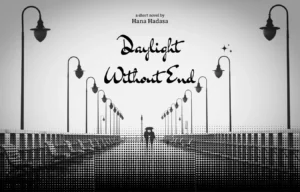
Part I — Dawn on the Boulevard
The city was waking up beneath a bruise-sky dawn — an uneasy mix of lavender and steel. Streetlamps blinked their last reluctant flashes as Metropole Avenue began to hum. A bus hissed into motion, its brakes wheezing like something half-forgotten. Pavement glistened from last night’s rain, and a stray bird hopped between puddles, pecking at reflections it could never quite reach.
Miles Rowan walked with a nervous energy he couldn’t quiet. Today was just another Monday, yet his mind felt like an overplayed record: skip here, static there, only the vague melody of a life he half-remembered. He adjusted his backpack strap and imagined his thoughts neatly packed, zipped up, labelled — anything to quiet the nagging sense that something important, something personal, had been left behind on a street corner marked only by rainwater and memory.
He crossed at the light, earbuds in, absent-mindedly listening to a podcast about urban mythology. A narrator spoke of cities as palimpsests — layers upon layers of stories, erased and rewritten by every resident who ever walked their streets. The idea amused him; he pictured the city peeling back its skin like pages in a diary, secrets splayed in ink and dust. He wondered if his own thoughts, too, were scribbles in an unseen notebook, awkwardly stitched together across time.
His destination was The Exchange, a sleek glass tower where he worked as a data analyst. The analytics team measured trends in everything from market sentiment to foot-traffic patterns, futuristic stuff that seemed more mathematical than human. Sometimes he wondered why he endured the fluorescent light and overlapping Zoom calls — but people needed numbers. Numbers needed interpretation. And here he was, heart half-inspired, half-indifferent, perched at a desk with coffee stains on his keyboard.
At the corner café, a woman in a sky-blue trench coat smiled at him — or so he thought. She was wearing lavender lipstick and reading a battered paperback, her fingers ink-smudged as though she lived with stories rather than just read them. Their eyes collided for a heartbeat, and the world felt momentarily fragile and miraculous. Then she turned a page, and the moment was gone.
Miles paid for his black coffee and took it to go. The barista, another morning fixture, offered a knowing nod — the kind that spoke of uncounted shared mornings, of barely noticeable affection between regular customers whose names were almost, but not quite, forgotten.
The sun climbed, color bleeding into the sky as if reluctant to commit to brightness. Miles took it all in — the rumble of buses, the staccato clack of heels on pavement, the quiet, intricate rhythm of people becoming a city.
Part II — Midmorning at The Exchange
Inside The Exchange, the air conditioning hummed with mechanical devotion. Screen glare filled the space where open-plan desks stood like obedient soldiers. Miles sat at desk 42A, logged into his suite of analytics dashboards, and pretended to focus.
His colleague, Simone, leaned over his cubicle wall, a mischievous grin on her face. She held two cups.
“Triple espresso,” she announced in a tone that suggested this was both necessary and therapeutic.
“Thanks,” he said, accepting the cup with mild gratitude. “I feel like my brain is starting to dissolve into the carpet.”
She laughed — a sound imbued with caffeine and patience. “Your ideas are too intense for 9:47 a.m.” Her eyes lit up. “I heard a rumor — the rooftop garden is hosting yoga today. Fifteen minutes. And then brunch.”
Miles tried to imagine yoga. His mind wobbled between balance and embarrassment, like he was negotiating with a committee of unsettled thoughts. “Maybe,” he said vaguely, knowing he’d probably be buried in datasets.
Simone shrugged and wandered off, a cascade of energy trailing behind her. Meanwhile, Miles opened his spreadsheet grid and tried to impose order on the unruly numbers before him.
Around midday, an email arrived that seemed entirely ordinary — save for a single line in the subject that read:
“Don’t forget today.”
That was it. No signature. No explanation. And yet his chest tightened, as though something hidden deep within him had blinked awake.
His lunch was unremarkable: a turkey wrap and an apple. Yet upon finishing, he felt the odd sensation that he was still hungry — not for food, but for something he couldn’t quite name.
He packed his wrappers and walked toward the rooftop. Simone was there, mat unfurled, greeting the midday sunlight like a friend she owed money.
“Need a break from the data?” she teased.
“No,” he said, “just curious about gravity.”
She laughed. “Close enough.”
They stretched like practiced contortionists — Simone fluid, Miles slightly awkward — but the open sky eased something in him. Not peace, exactly, but clarity: a sense that his thoughts were less fragmented when exposed to open air.
Above them, the city exhaled in heat and light.
Part III — Afternoon Reveries
The afternoon became a blur of meetings and manufactured productivity. Somewhere between a charts review and a performance summary, his mind drifted back to the strangely cryptic email. Today. Don’t forget today. Was it a reminder? A warning? A prank?
The day stretched into something both sharp and unformed — like a question without a verb.
He decided to walk a circuitous route home — down Music Row, past a mural that depicted an ocean of dancing butterflies, and beneath a canopy of electric signage that promised dinner deals and concerts. The city never stopped telling stories, and perhaps that was the point: every sign, every echo, every face in the crowd was a tiny testament to the chaos of information that made up a lifetime.
A busker played violin near the corner of 8th and Main — a wistful piece that felt like unspoken longing. Miles dropped a crumpled bill into the open guitar case, then paused, listening. The melody was simple, yet somehow profound, as though the violin slipped inside memories better left unexamined.
He had a sudden thought: perhaps lists and dashboards were no substitute for living.
Strange, really, how clarity sometimes came not in thinking about things but in moments when thought simply paused — like a hesitant breath.
He continued walking, passing people who seemed luminous in their ordinariness. A mother held her child’s hand. Two old friends laughed without embarrassment. A delivery driver balanced bags in each hand and smiled at nothing in particular.
It was all profoundly ordinary. And strangely comforting.
Part IV — Evening Encounters
At a wine bar called The Inkpot, people in business casual sipped rosé and argued over books like currency. Miles found himself seated—alone—nursing an afterthought disguised as an inexpensive merlot.
The woman beside him wore a charcoal blazer and had the sort of contemplative air that made people assume she was either an artist or chronically disappointed by mainstream philosophy.
“Quiet night?” she asked.
“Or usual,” he replied.
She raised an eyebrow. “Meaning?”
“I mean,” he said, swirling his glass, “that maybe ordinary is underrated.”
She laughed — a burst of warmth that seemed entirely sincere. “That sounds like something someone would say after a rough day.”
He shrugged. “Or a reflective one.”
Her eyes were attentive but not intrusive — a rare quality that made conversation effortless.
“I’m Petra,” she said.
“Miles,” he replied.
They sat in a companionable quiet for a moment.
“You look like you have a story in progress,” she said.
“Progress? Perhaps. Completion? Unlikely.”
She grinned. “I write essays about urban absurdities. Maybe we should compare notes.”
He realized he was smiling too.
Conversation flowed — effortless, playful, unguarded — until it felt less like exchange and more like discovery. Words were shared, thoughts elaborated, stories unfolded like petals in slow motion.
He recounted snippets of his day — the email, the rooftop yoga, a violin cast in golden lamplight — and she listened with a curiosity that neither felt judged nor intrusive.
“What if the message was just a nudge?” she asked. “Not to remember something specific — but to notice today?”
He paused, considering the idea.
Notice today. Not control it. Not solve it. Not organize it into neat compartments.
Just notice it.
He liked that.
Part V — Night and Reflection
The bar grew quiet. Lights dimmed. A jazz trio played a breezy tune like evening sunlight caught in motion.
Miles and Petra finished their glasses.
“Same time tomorrow?” she asked.
He hesitated. Usually he avoided commitments that had no clear metric or indicator of future meaning.
But then he remembered the email.
Don’t forget today.
Maybe that was the point. Not the metric. Not the reason. Just the act of being present.
“Sure,” he said.
She smiled — not enthusiastically, just gently.
As they stepped out into the night air, the city’s lights shimmered like scattered constellations. People moved in every direction, humming through their routines, their visions, their hidden joys and private sorrows.
Miles thought back over the day — the hum of morning buses, the rooftop breeze, the violin’s melancholy, the bar’s laughter — and something settled in him like an answer that wasn’t an answer.
He didn’t know what tomorrow would bring.
But tonight?
Tonight was vivid. Strange. Rich with unexamined possibility.
He reached into his pocket for his phone — then stopped.
Maybe some moments were meant to be felt, not documented.
Epilogue — Anticlimax and Continuity
The next morning, Miles woke to another email.
No subject. No message. Just a line of text:
“Today, remember to notice.”
He stared at it for a long moment.
A smile formed — small, tentative, human.
He walked outside into the hush of sunrise — the city yet to stir, the horizon soft with promise.
And instead of rushing, calculating, predicting, or organizing, he simply stood there and breathed.
For a moment — just a moment — he noticed nothing extraordinary.